
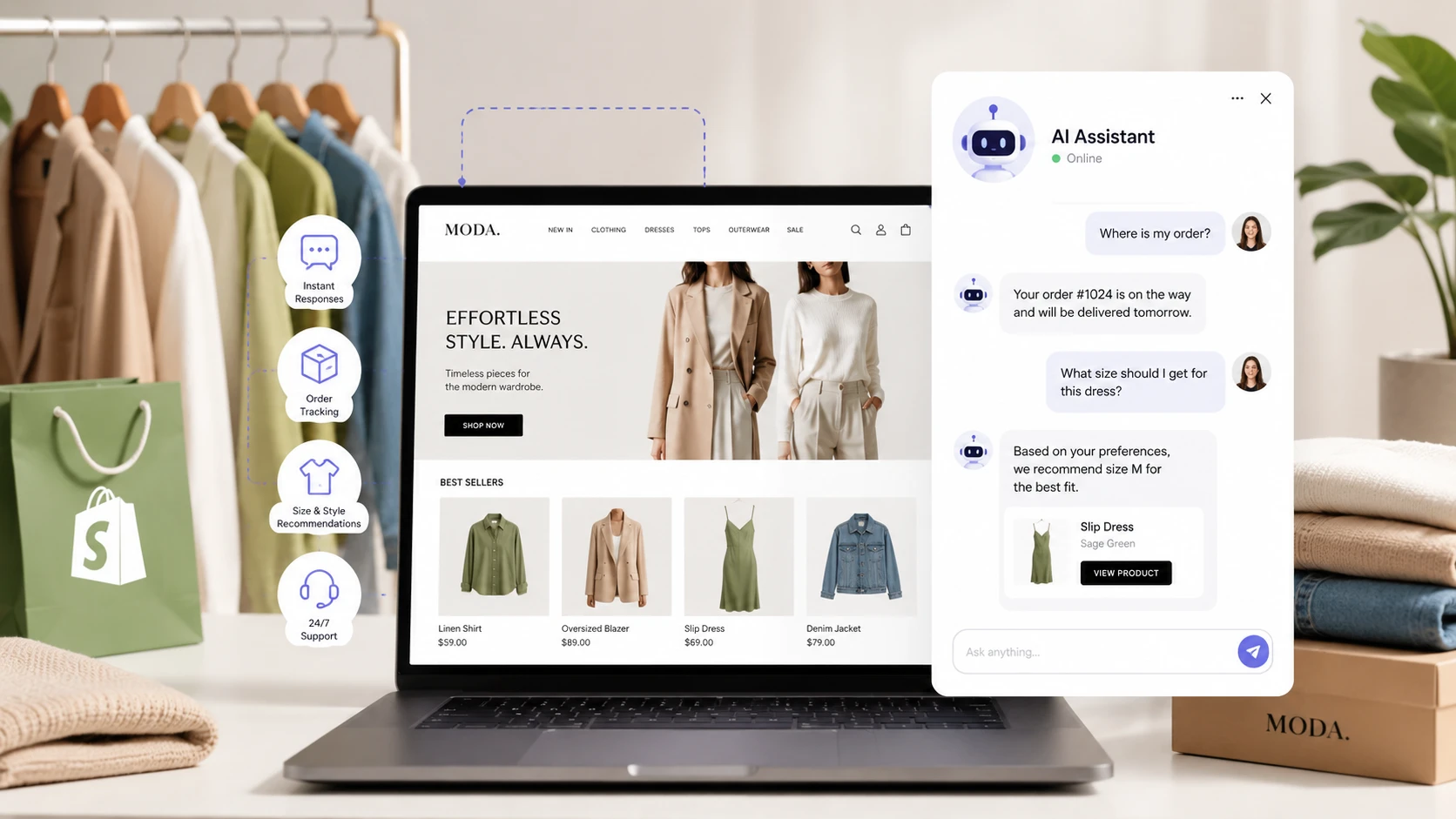
Quick Answer: An AI agent for ecommerce is an autonomous system that can answer customer questions, recommend products, support returns, check order details, and guide shoppers through buying decisions without constant human oversight. For Shopify clothing stores, the real value is not just “having a chatbot,” but building a smarter customer support and sales layer that works across the full shopping journey.
Picture this: it is 2 AM, and someone in Tokyo is searching your store for the perfect birthday gift. At the same time, a customer in Berlin needs help processing a return, while someone in Chicago cannot decide between two product variants. Five years ago, you would need a global support team working around the clock. Today, a properly configured AI agent for ecommerce can handle all three conversations at once — and in many cases, do it faster than a tired support team after their fourth coffee.
The shift happening right now is not just about chatbots getting smarter. We are watching ecommerce support move from simple “helpful assistant” tools into systems that can actually run meaningful parts of the customer experience: answering questions, qualifying needs, recommending products, reducing abandoned carts, and escalating complex cases to humans only when needed.
For Shopify clothing stores, this matters even more. Fashion ecommerce has a lot of repetitive but important questions: sizing, fabric, shipping, returns, outfit matching, product availability, and “which one should I choose?” If those questions are not answered quickly, shoppers leave.
That is where AI agents become useful.
If you are building a more advanced ecommerce operation, this type of automation can also connect naturally with broader AI services, store automation, and custom software development workflows.
What Is an AI Agent for Ecommerce?
Let’s cut through the marketing noise for a second.
An AI agent for ecommerce is not just a pop-up chat window that says “How can I help you today?” and then fails to understand a simple question. A real AI agent can use store data, product information, customer context, order status, and business rules to take useful actions or guide a customer toward the next best step.
Traditional ecommerce chatbots usually follow fixed scripts. They wait for a trigger, match a keyword, and return a pre-written answer. That can be useful, but it is limited.
AI agents are different because they can understand context, remember the conversation, make decisions within rules, and adapt their response based on what the customer is actually trying to do.
Think of the difference like this:
Traditional automation is a vending machine. Press B4, get chips.
An AI agent is closer to a trained store employee who remembers customer preferences, notices that someone is browsing winter coats in July, understands that they might be planning a trip, and adjusts the recommendation accordingly.
Why Shopify Clothing Stores Are a Strong Use Case
Shopify clothing stores are one of the clearest use cases for ecommerce AI agents because customers usually need help before they buy.
A shopper might like a product but still hesitate because of size, fit, delivery time, return rules, or uncertainty about whether the item matches something they already own. These small doubts often become abandoned carts.
The problem is not always product quality. Sometimes the problem is silence.
A customer asks a question. Nobody answers quickly. They leave.
An AI agent can reduce that gap by giving immediate, useful guidance at the moment the shopper is still interested.
For clothing stores, this can include:
- Size and fit guidance: Helping shoppers choose the right size based on product notes, previous purchases, or store rules.
- Product recommendations: Suggesting similar items, matching accessories, or better alternatives when something is out of stock.
- Return and exchange support: Explaining return rules, starting return flows, or guiding customers to the correct next step.
- Order tracking: Checking order status and giving customers direct updates instead of sending them to a generic help page.
- Cart recovery support: Answering last-minute doubts before the customer abandons checkout.
This is why an AI agent for ecommerce is not just a support tool. It can become part of the sales system.
The Core Capabilities of a Real AI Agent for Ecommerce
Not every chatbot should be called an AI agent. The label only makes sense when the system can do more than respond with canned answers.
A useful ecommerce AI agent usually has four core capabilities.
1. Autonomous Decision-Making
The agent should not need a human to approve every basic action. It should be able to answer common questions, suggest products, provide policy information, and guide routine processes on its own.
That does not mean it should have unlimited control. It still needs boundaries. For example, it may be allowed to explain a return process, but not approve unusual refunds without human review.
Good automation gives the agent enough freedom to be useful without letting it create business risk.
2. Contextual Understanding
A real AI agent should understand the customer’s situation, not just the words in one message.
If someone asks, “Will this fit me?” while viewing a specific jacket, the agent should know which product they are looking at. If someone asks, “Can I return it?” after checking the size guide, the agent should understand the concern is probably about fit risk.
This context is what makes the experience feel useful rather than robotic.
3. Multi-Channel Continuity
Customers do not always stay in one channel. They may start on live chat, continue through email, then come back later from a phone or desktop browser.
A stronger AI agent setup can maintain context across channels, or at least make sure the handoff does not feel broken.
That matters because customers hate repeating themselves. If they already explained the problem once, the system should not treat them like a stranger every time.
4. Goal-Oriented Behavior
A normal chatbot is designed to “reply.” An AI agent should be designed to achieve outcomes.
In ecommerce, those outcomes might include:
- Answering a question clearly.
- Helping the customer choose the right product.
- Reducing return risk.
- Recovering an abandoned cart.
- Escalating complex problems to a human quickly.
The goal is not to automate for the sake of automation. The goal is to make the customer journey easier and the store operation more efficient.
How an AI Agent Works Inside an Ecommerce Store
Let’s make this practical.
When a customer lands on your Shopify store, a properly configured AI agent can start using context before the customer even asks a question. It may consider the page being viewed, product category, cart status, browsing behavior, and previous interactions if available.
The agent does not need to interrupt every visitor. In fact, aggressive pop-ups usually hurt the experience. A better implementation waits for useful moments: hesitation, repeated product views, cart inactivity, or direct customer questions.
The Customer Support Automation Layer
This is where most businesses start, and for good reason.
AI customer support for ecommerce can handle a large percentage of routine inquiries when the system is connected to the right data sources.
For example, when someone asks, “Where is my order?” the agent should not simply send a generic tracking page. It should check the customer’s order, identify the shipping status, and provide a clear answer.
When someone asks about returns, the agent should explain the policy, guide the customer through the process, and hand off to a human if the case is unusual.
This layer can reduce pressure on support teams while improving response speed for customers.
The Product Discovery and Sales Layer
Support is only one part of the value.
An ecommerce AI agent can also help shoppers discover the right products. This is especially useful in clothing, accessories, beauty, electronics, and any category where customers compare options before buying.
Instead of showing generic recommendations, the agent can ask a few simple questions and narrow the options:
- What occasion are you buying for?
- Do you prefer a loose or fitted style?
- What size do you usually wear?
- Are you looking for something casual, formal, or seasonal?
This feels closer to assisted shopping than standard ecommerce filtering.
For stores that want to go further, AI can also connect with tools like virtual try-on, product matching, and personalized shopping flows. This is where AI virtual try-on software becomes relevant for clothing brands that want a more visual buying experience.
The Retention and Post-Purchase Layer
A strong AI agent does not stop after checkout.
Post-purchase support is one of the biggest opportunities in ecommerce automation. The agent can help with tracking, delivery questions, return instructions, review requests, reorder reminders, and product care guidance.
This is not always glamorous, but it has a direct impact on customer satisfaction.
A shopper who gets quick help after buying is more likely to trust the store again.
What AI Agents Can Automate in a Shopify Clothing Store
For a Shopify clothing store, the most practical use cases are usually simple, repetitive, and high-volume.
Here are the areas where an AI agent can make a visible difference.
Product Questions
Customers often ask about fabric, fit, measurements, colors, washing instructions, availability, or whether an item matches another product.
If your product data is organized properly, the AI agent can answer these questions quickly without waiting for a human.
This is one of the easiest areas to automate because the answers usually already exist somewhere in your product descriptions, size guides, policies, or internal notes.
Size Guidance
Sizing is one of the biggest friction points in fashion ecommerce.
An AI agent can guide customers through size selection by asking structured questions and referencing your size chart. It can also explain whether an item runs small, large, fitted, oversized, or true to size if that information exists in your store data.
This does not eliminate returns completely, but it can reduce avoidable mistakes.
Order Tracking
Customers asking “Where is my order?” are not trying to have a conversation. They want a fast answer.
An AI agent connected to order and shipping data can provide that answer instantly. This saves time for both the customer and the support team.
Returns and Exchanges
Returns are repetitive, but they must be handled carefully.
The agent can explain the return window, check eligibility, guide the customer through the steps, and collect the required information. For unusual cases, it can escalate to a human with the context already prepared.
Abandoned Cart Recovery
Sometimes a shopper abandons a cart because of a question that was never answered.
An AI agent can help before that happens. If a customer is stuck on a product page or checkout step, the agent can offer specific help instead of generic discount pop-ups.
For example:
- “Need help choosing the right size?”
- “Want to compare this with a similar item?”
- “Looking for delivery information before checkout?”
This is more useful than shouting “10% off” at every visitor.
Common Myths About AI Agents for Ecommerce
Let’s address a few myths that still create confusion.
Myth 1: AI Agents Will Replace All Human Support Staff
No. At least, not in a healthy setup.
What usually happens is that the support team stops answering the same basic questions all day and starts handling the cases that actually need human judgment.
The agent handles volume. Humans handle nuance.
That means your best support people can focus on difficult customers, sensitive cases, high-value orders, and improving the customer experience instead of repeating “Here is our return policy” for the hundredth time.
Myth 2: You Can Set It and Forget It
Also no.
An AI agent for ecommerce needs training, monitoring, and refinement. It is closer to having a smart assistant that learns quickly but still needs guidance on your policies, tone, product logic, and escalation rules.
You will still need to review edge cases, improve product data, update policies, and adjust the agent’s behavior based on real conversations.
It is less work than scaling a large support team, but it is not zero work.
Myth 3: Only Big Brands Can Afford This
This used to be more true than it is now.
Small and mid-sized ecommerce stores are often strong candidates because they feel the pain of support volume earlier. They may not have the budget for a large customer service team, but they still need fast answers and consistent support.
The key is choosing the right implementation level. Not every store needs a complex custom agent on day one.
The Right Way to Implement an AI Agent
The safest approach is not to automate everything at once.
Smart stores start with one controlled use case, prove value, and then expand.
Phase 1: After-Hours Support
A simple first step is to deploy the AI agent outside business hours.
Your human team continues handling normal daytime support, while the agent covers nights, weekends, and time zones your team cannot reach easily.
This gives you a lower-risk way to test quality, train the system, and discover common gaps.
Phase 2: Tier-1 Questions During Business Hours
Once the agent performs well, it can start handling simple questions during normal hours too.
These might include:
- Order tracking.
- Return policy questions.
- Basic product information.
- Size guide explanations.
- Shipping time questions.
Humans should remain available for escalations.
Phase 3: Sales Assistance and Personalization
After support automation is stable, the next step is sales assistance.
This is where the agent starts helping shoppers choose products, compare options, and receive better recommendations.
At this stage, the agent becomes part of the revenue system, not just the support system.
Integration Requirements You Should Check First
Before choosing any AI agent platform, check whether it can actually connect to the systems your store already uses.
This is where many ecommerce AI projects succeed or fail.
A nice demo is not enough. The agent needs reliable access to the right data, and it needs clear rules for what it can and cannot do.
Essential Integrations
At minimum, an AI agent for ecommerce usually needs access to:
- Your ecommerce platform: Shopify, WooCommerce, or a custom store backend.
- Product catalog: Product titles, descriptions, variants, images, stock status, and pricing.
- Order data: Order status, customer details, payment status, and fulfillment updates.
- Shipping tools: Tracking numbers, carrier updates, delivery estimates, and failed delivery notes.
- Store policies: Returns, refunds, shipping rules, exchanges, warranty, and support terms.
Without these connections, the agent becomes a smarter FAQ tool. With them, it becomes a real operational assistant.
Advanced Integrations
More advanced stores may also connect the agent to:
- CRM systems.
- Email marketing tools.
- Loyalty programs.
- Inventory management systems.
- Analytics platforms.
- ERP or custom internal systems.
This is where custom software development may become necessary, especially if your store uses custom workflows that standard apps cannot handle cleanly.
How to Choose the Right AI Agent for Ecommerce
The market is full of tools calling themselves AI agents, AI chatbots, AI assistants, or customer support automation platforms. The names are less important than what the system can actually do.
Here are the criteria that matter.
1. Can It Take Real Actions?
There is a big difference between a tool that says, “You can return your item from the returns page,” and a tool that can actually start the return process.
The more actions the agent can safely perform, the more valuable it becomes.
Useful actions might include:
- Checking order status.
- Starting a return request.
- Recommending available products.
- Collecting customer details before escalation.
- Creating a support ticket.
- Sending a product or policy link.
Start with safe actions first, then expand gradually.
2. How Does It Learn Your Store?
Some AI tools require heavy manual setup. Others can learn from your product catalog, help center, policy pages, previous support conversations, and internal documents.
Both approaches can work, but you need to know what is required before you start.
For a clothing store, the agent should understand:
- Product categories.
- Size guides.
- Fabric and material details.
- Shipping rules.
- Return policy details.
- Brand tone and style.
Poor training creates vague answers. Good training creates a useful assistant.
3. Does It Escalate Properly?
Escalation is one of the most important parts of ecommerce AI support.
A bad AI agent keeps guessing when it should stop. A good AI agent knows when to bring in a human.
Escalation should happen when:
- The customer is angry or frustrated.
- The case involves payment problems.
- The agent is not confident.
- The request is outside the store’s policy.
- The customer asks for a human.
- The order value or risk level is high.
The handoff should include the conversation history so the human support agent does not need to ask the customer to repeat everything.
4. Can You Control the Brand Voice?
Your AI agent should not sound like a generic corporate robot.
If your brand is playful, the agent should feel friendly and light. If your brand is premium, it should feel polished and calm. If your audience is technical, it can be more direct and detailed.
Brand voice matters because the AI agent becomes part of the customer experience. Customers may not analyze the tone consciously, but they will feel when something is off.
Risks and Limitations You Should Not Ignore
AI agents can be powerful, but they are not magic. There are real risks, and pretending they do not exist is how bad implementations happen.
Incorrect Answers
AI systems can sometimes generate confident answers that are wrong. In ecommerce, that can mean incorrect product details, wrong delivery expectations, or policy confusion.
The solution is to ground the agent in verified store data, restrict risky actions, and create clear escalation rules.
Weak Product Data
If your product data is messy, the AI agent will struggle.
For example, if size charts are inconsistent, product descriptions are thin, and return rules are unclear, the agent has weak material to work with.
Before blaming the AI, check the data.
Over-Automation
Not every customer interaction should be automated.
Some situations need empathy, negotiation, or human judgment. If the agent blocks customers from reaching a human, it can damage trust quickly.
The goal is not to hide your support team. The goal is to let the AI handle repetitive work while humans handle the cases that deserve human attention.
Privacy and Compliance
An ecommerce AI agent may process customer names, order information, messages, browsing behavior, and purchase history.
That means privacy matters.
You need to understand how the platform stores data, whether it uses customer conversations for training, what security controls exist, and whether it supports relevant privacy requirements in your market.
For broader context on ecommerce AI use cases, Shopify’s guide to AI in ecommerce is a useful industry reference.
How to Measure Success
Do not judge an AI agent only by how many messages it sends. That number alone does not mean much.
Measure whether it improves the business.
Support Metrics
Start with operational metrics:
- Response time: How quickly customers get a useful answer.
- Resolution rate: How many conversations are solved without human intervention.
- Escalation rate: How often the agent needs a human.
- Customer satisfaction: Whether customers are happy with the answer.
- Support workload: Whether repetitive tickets decrease.
These metrics tell you if the agent is actually helping your support process.
Sales Metrics
For ecommerce, support is only part of the picture.
You should also look at:
- Conversion rate.
- Cart abandonment rate.
- Average order value.
- Repeat purchase rate.
- Revenue from assisted sessions.
A good AI agent can improve sales by answering objections at the right moment, helping customers choose, and making the buying process feel easier.
When an AI Agent Is Worth It — and When It Is Not
An AI agent for ecommerce is not necessary for every store.
It is usually worth exploring if:
- You receive repeated customer questions every week.
- Your team spends too much time answering basic support tickets.
- You sell products that require explanation or comparison.
- Your store serves customers in different time zones.
- You lose sales because shoppers do not get quick answers.
- You are scaling and support costs are growing with revenue.
You may want to wait if:
- Your store has very little traffic.
- Your product data is incomplete or messy.
- Your policies change constantly.
- You do not have anyone who can monitor and improve the system.
The technology is no longer experimental, but it still needs a responsible setup.
Final Thoughts
An AI agent for ecommerce is not just a trend or a fancy chatbot. When implemented properly, it becomes a practical layer between your customers, products, policies, and support team.
For Shopify clothing stores, the opportunity is clear. Customers need help with size, fit, availability, shipping, returns, and product choices. If those questions are answered quickly and naturally, the store has a better chance of converting visitors into buyers.
The right approach is not to automate everything overnight. Start with the repetitive support questions. Connect the agent to reliable store data. Set clear escalation rules. Then expand into product recommendations, cart recovery, and post-purchase automation.
Done well, an AI agent does not replace the human side of ecommerce. It protects it by removing repetitive work and giving people more time for the conversations that actually need them.
If you want to build a more advanced customer support or ecommerce automation system, JustOnePrompt can help connect AI agents with Shopify workflows, store data, and custom automation logic through AI services and store automation.
Frequently Asked Questions
What is an AI agent for ecommerce?
An AI agent for ecommerce is an autonomous system that helps customers across the buying journey. It can answer questions, recommend products, support returns, check order information, and escalate complex issues to humans when needed.
How is an AI agent different from a normal ecommerce chatbot?
A normal chatbot usually follows fixed scripts or simple keyword rules. An AI agent can understand context, use store data, make decisions within defined rules, and guide customers toward useful outcomes.
Do Shopify clothing stores really need an AI agent?
Not every store needs one immediately, but Shopify clothing stores with repeated questions about sizing, returns, shipping, product recommendations, or order tracking can benefit from an AI agent because it reduces response time and helps customers make buying decisions.
Can an AI agent increase ecommerce sales?
Yes, when implemented well. An AI agent can increase sales by answering product questions quickly, reducing abandoned carts, recommending relevant products, and helping customers feel more confident before checkout.
Will an AI agent replace human support?
Usually no. The best setup uses AI agents for repetitive questions and routine workflows, while human support handles complex, emotional, sensitive, or high-value cases.
How long does it take to implement an AI agent in a Shopify store?
A basic implementation can take a few days if the store uses standard Shopify apps and clear policies. A more advanced setup with custom workflows, integrations, and brand-specific training may take several weeks.
What should I prepare before using an ecommerce AI agent?
You should prepare clear product data, size guides, return policies, shipping rules, support FAQs, escalation rules, and examples of your brand voice. The better your data, the better the AI agent will perform.