

Generative AI for ecommerce is a practical way to create product content, improve recommendations, personalize shopping journeys, and automate customer conversations without turning your store into a cold, robotic machine.
I’m gonna be honest with you: when I first heard about generative AI transforming ecommerce, I pictured robot shop assistants writing poetry about sneakers. Turns out, it’s way cooler than that—and way more practical.
Picture this: you’re running an online store with 10,000 products. Every single one needs a description, probably multiple versions for different channels. Your copywriter just laughed hysterically and quit.
This is where generative AI for ecommerce walks in like a caffeinated superhero, ready to write, optimize, personalize, and support customers faster than a manual team could ever manage alone.
But here’s the thing: this technology is not just about cranking out product descriptions. It is changing how customers shop, how stores recommend products, how teams manage content, and how smart automation can increase upsells without making the experience feel pushy.
Let’s dig into what actually matters.
What Exactly Is Generative AI for Ecommerce?
Unlike traditional AI that mostly analyzes existing data or follows predefined rules, generative AI can create new content and responses from patterns it has learned.
Think of it as the difference between a librarian who organizes books and an author who writes them.
In the ecommerce context, this means AI systems that can:
- Write product descriptions for different customer segments
- Create product images, banners, and visual concepts
- Generate personalized recommendations based on customer behavior
- Answer customer questions in a more natural conversational style
- Suggest product bundles, upsells, and cross-sells in real time
- Support demand forecasting, inventory planning, and pricing decisions
The useful part is not that AI can generate words. Lots of tools can generate words. The useful part is that generative AI can connect content, customer intent, product data, and automation into one smarter ecommerce workflow.
How It Differs From Traditional Ecommerce Automation
Traditional automation follows basic if-then logic.
If a customer abandons a cart, send an email.
If a product is out of stock, show a notification.
If someone buys product A, recommend product B.
That is still useful. But it is also rigid.
Generative AI adapts to context. It can look at browsing behavior, product interest, customer history, the current page, and the tone of the interaction, then generate a more relevant response or recommendation.
Traditional automation says: “People also bought this.”
Generative AI can say: “Because you are buying hiking boots for wet weather, this waterproof spray and wool sock bundle will probably be useful.”
That small difference matters. One feels like a generic algorithm. The other feels like helpful guidance.
Why Generative AI for Ecommerce Matters Right Now
Customer expectations have gone up. Attention spans have gone down. Shoppers want fast answers, relevant recommendations, clear product details, and a buying experience that feels personal.
Manual processes cannot keep up with that demand at scale.
Even a strong marketing team cannot write personalized content for thousands of customers every day. Even a good support team cannot answer every repeated question instantly. Even a smart store owner cannot manually test every upsell message, product bundle, and recommendation path.
This is where AI-powered ecommerce automation starts to become useful, especially when it supports real business goals instead of just adding another shiny tool.
Generative AI helps with three major pain points:
- Content bottlenecks: Product descriptions, category copy, ad variations, email content, and landing page text can be created faster.
- Personalization gaps: Stores can show more relevant messages, bundles, and product suggestions without manually building thousands of variations.
- Service scalability: Customer questions can be answered faster while human support teams focus on complex cases.
The Business Case Nobody Talks About
Most people talk about conversion rates. That makes sense. More sales are good.
But there is another benefit that store owners feel very quickly: operational sanity.
When your team is not drowning in repetitive product content, basic support questions, and manual recommendation setup, they can spend more time on strategy.
That means better product positioning, better campaigns, better customer experience, and fewer chaotic last-minute fixes.
Generative AI does not magically solve bad operations. But when connected to the right workflows, it removes a lot of the repetitive work that slows ecommerce teams down.
Core Applications of Generative AI in Ecommerce
Generative AI sounds broad, so let’s make it practical. These are the areas where it can actually help ecommerce businesses.
1. Product Descriptions That Scale Without Losing Brand Voice
Product content is one of the biggest bottlenecks in ecommerce.
Every product may need:
- A short description for mobile users
- A longer description for product pages
- SEO-friendly category content
- Email copy
- Ad variations
- Social media captions
- Different messaging for different customer groups
Now multiply that by hundreds or thousands of SKUs.
This is where generative AI can save serious time. It can create first drafts based on product data, brand tone, target audience, and selling points. A human editor can then review, improve, and approve the final copy.
That hybrid model is usually the best approach: AI handles speed, humans handle judgment.
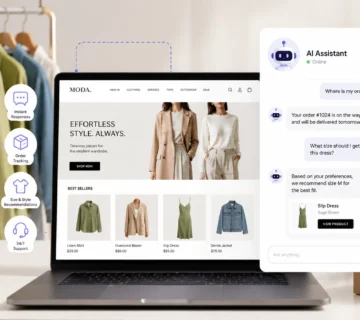
2. Conversational Commerce and Better Customer Support
Forget the old chatbot experience where every answer sounds like it came from a broken FAQ page.
Modern generative AI can understand customer questions more naturally. It can ask follow-up questions, explain product differences, suggest options, and guide shoppers toward the right choice.
For example, a customer might ask:
“I need something for my teenager’s first camping trip. What should I buy?”
A basic chatbot might search for the word “camping” and show random products.
A better generative AI assistant can ask about the weather, trip length, budget, and experience level, then suggest a practical kit with a clear explanation.
For stores with complex products, this becomes even more valuable. Fashion, electronics, industrial supplies, beauty products, supplements, and home equipment all involve questions that customers want answered before buying.
The goal is not to pretend AI is a human. The goal is to make the buying journey easier.
For more detail on this area, Ecommerce Conversational AI: Turning Chatbots into Sales Assistants is a useful next read.
3. AI Upsell Automation That Feels Helpful, Not Pushy
This is where things get interesting for revenue.
AI upsell automation uses customer behavior, cart contents, product relationships, and buying intent to recommend better upgrades, bundles, or add-ons.
A basic upsell system might say:
“Add this product to your cart.”
A smarter generative AI system can explain why the add-on makes sense.
For example:
- If someone buys a camera, suggest a memory card and protective case.
- If someone buys running shoes, suggest socks based on the shoe type and season.
- If someone buys skincare products, suggest a routine instead of a random extra item.
- If someone buys a Shopify app subscription, suggest setup or automation support.
The difference is context.
A thoughtful upsell does not feel like pressure. It feels like assistance. That is why generative AI for ecommerce can be powerful for increasing average order value when it is used carefully.
4. Personalized Product Recommendations
Traditional product recommendations are usually based on simple patterns:
- Customers also bought
- Recently viewed
- Best sellers
- Similar products
These are useful, but limited.
Generative AI can make recommendations more contextual. It can generate different messages for different customers, even when the product recommendation is the same.
For example, the same laptop can be positioned differently:
- For a student: affordable, portable, and good for study
- For a designer: screen quality, performance, and creative software support
- For a business user: battery life, reliability, and productivity
Same product. Different angle. Better relevance.
That is the real power of personalization.
5. Visual Content and Product Presentation
Generative AI is also useful for visual ecommerce content.
Stores can use it to create:
- Ad concepts
- Product lifestyle images
- Banner variations
- Seasonal campaign visuals
- Background ideas for product photography
- Mockups for landing pages
This does not mean every image should be fake or fully AI-generated. Product accuracy still matters, especially for clothing, furniture, cosmetics, and any item where customers care about exact details.
But for concept creation, campaign testing, and visual planning, generative AI can shorten the creative cycle significantly.
6. Operations and Supply Chain Intelligence
Not all valuable AI work happens on the customer-facing side.
Generative AI can also support backend ecommerce operations, especially when combined with analytics and automation systems.
Useful areas include:
- Demand forecasting: Understanding which products may sell more during certain periods.
- Inventory planning: Reducing stockouts and overstock by improving predictions.
- Dynamic pricing support: Helping teams evaluate price changes based on demand, margin, and competition.
- Product data cleanup: Fixing inconsistent titles, missing attributes, and weak descriptions.
- Workflow suggestions: Identifying repetitive operational tasks that can be automated.
This part is less glamorous than AI chatbots and product images, but it can have a major impact on profit.
Bad inventory decisions are expensive. Slow product publishing is expensive. Disconnected workflows are expensive.
Smart automation helps reduce that waste.
How to Implement Generative AI in Your Ecommerce Business
The biggest mistake companies make is trying to transform everything at once.
That usually leads to confusion, tool overload, blown budgets, and a team that quietly starts ignoring the whole AI initiative.
Start smaller.
Not “we want AI in our ecommerce business.”
That is too vague.
Start with something specific:
- Reduce support questions about size and fit
- Create better product descriptions for 500 old products
- Improve upsell recommendations on cart and checkout pages
- Generate email variations for abandoned cart campaigns
- Personalize product bundles for repeat customers
Specific problems are easier to automate, easier to measure, and easier to improve.
Step 1: Identify the Biggest Bottleneck
Look at where your team loses the most time.
Is it product content?
Customer service?
Upsell setup?
Manual reporting?
Poor product data?
Slow campaign creation?
Choose one bottleneck that affects revenue, time, or customer experience. That becomes your first AI use case.
Step 2: Prepare Your Product and Customer Data
Generative AI is only as useful as the data and instructions behind it.
Before connecting AI tools, clean the basics:
- Product titles
- Descriptions
- Prices
- Categories
- Images
- Attributes
- Customer questions
- Support history
- Order patterns
If your product data is messy, AI will produce messy output faster. That is not progress. That is just automated chaos.
Step 3: Match the Tool to the Problem
Not every AI tool is good for every ecommerce problem.
Use the right tool for the right job:
- Content generation tools for product descriptions, category pages, ads, and emails.
- Conversational AI tools for chatbots, guided selling, and customer support.
- Recommendation systems for upsells, cross-sells, bundles, and personalization.
- Workflow automation tools for connecting Shopify, WooCommerce, CRM, email, WhatsApp, and reporting systems.
A store does not need every AI feature on day one. It needs the right feature connected to the right business problem.
Step 4: Integrate Instead of Adding More Isolated Tools
This is important.
Generative AI works best when it connects with your existing ecommerce system, CRM, inventory data, analytics, and marketing tools.
A standalone AI tool might look impressive in a demo. But if it does not connect to your real store operations, it creates another silo.
That is why integration matters.
For example, an AI assistant becomes much more useful when it can understand:
- Current product availability
- Customer order history
- Shipping rules
- Return policy
- Product variants
- Promotions
Without integration, it can only give generic answers. With integration, it can support actual buying decisions.
If conversational selling is part of your plan, How to Use Chatbot for Ecommerce Sales and Conversions explains the practical direction more clearly.
Step 5: Keep Human Review in the Workflow
Generative AI should not run your ecommerce store without supervision.
At least not at the beginning.
Use human review for:
- Product descriptions
- Medical, legal, or sensitive claims
- Pricing changes
- Brand-sensitive customer messages
- High-value customer support cases
- Visual assets that must match real products accurately
The best setup is usually not AI versus humans. It is AI doing the repetitive first draft and humans improving the final output.
Common Myths About Generative AI in Ecommerce
Myth 1: “It Will Replace My Entire Team”
Generative AI does not remove the need for human judgment.
It changes the type of work your team does.
Your content team may spend less time writing every first draft and more time defining brand voice, improving prompts, reviewing output, and planning campaigns.
Your support team may spend less time answering repeated questions and more time handling complex issues.
Your marketing team may spend less time manually creating variations and more time analyzing what actually performs.
That is not replacement. That is leverage.
Myth 2: “Only Enterprise Companies Can Use It”
This used to feel true.
Now, many AI tools are available as SaaS products, plugins, apps, APIs, or built-in features inside ecommerce platforms.
Small and mid-sized stores can start with narrow use cases:
- AI product descriptions
- AI chat support
- AI email variations
- AI bundle suggestions
- AI reporting summaries
You do not need to build a full AI department to start. You need a focused use case and a clean implementation plan.
Myth 3: “AI Content Always Sounds Robotic”
Bad AI content sounds robotic.
Good AI-assisted content can sound natural when the system has clear instructions, good examples, and human review.
The problem is usually not the AI model alone. The problem is weak prompting, poor brand guidelines, and publishing raw output without editing.
Generative AI should produce a strong draft. Your team should make it sound like your brand.
Myth 4: “More Automation Always Means Better Results”
No.
Bad automation can damage the customer experience.
A pushy upsell popup, a confusing chatbot, or a generic AI description can reduce trust. The goal is not to automate everything. The goal is to automate the right things in a way that helps customers make better decisions.
Helpful beats aggressive.
Relevant beats noisy.
Clear beats clever.
Real-World Ecommerce Scenarios
Let’s make this concrete with a few practical scenarios.
Scenario 1: A Fashion Store With Too Many New Products
A clothing store launches new seasonal collections every few months. Each launch includes hundreds of products, and every product needs descriptions, size guidance, campaign text, and social content.
Before AI, the team spends weeks preparing content.
With generative AI, the system creates first drafts based on product attributes, collection theme, material, style, and target audience. Editors then review and refine.
The store still controls the brand voice. But the launch process becomes faster and less painful.
Scenario 2: A Shopify Store That Wants Smarter Upsells
A Shopify store wants to increase average order value without annoying customers.
Instead of showing the same upsell to everyone, generative AI helps create different recommendations based on cart content and buyer intent.
A customer buying a phone case may see a screen protector bundle.
A customer buying a premium bag may see care products.
A customer buying gym clothes may see a complete training outfit suggestion.
The upsell becomes more useful because the message explains the reason behind the recommendation.
Scenario 3: A WooCommerce Store With Repeated Support Questions
A WooCommerce store receives the same questions every day:
- Which size should I choose?
- How long does shipping take?
- Can I return this item?
- Which product is better for my case?
- Is this item compatible with another product?
A generative AI assistant can answer simple questions, guide users to the right products, and send complex cases to a human.
This reduces support pressure while keeping the buying journey moving.
Risks and Limits You Should Not Ignore
Generative AI is useful, but it is not magic.
There are real risks.
- Incorrect information: AI may generate confident but inaccurate answers if your data is weak.
- Brand inconsistency: Without clear guidelines, content may not sound like your store.
- Product accuracy issues: Visual or written output must not misrepresent the real product.
- Privacy concerns: Customer data should be handled carefully and only with trusted systems.
- Over-automation: Too many popups, messages, and AI suggestions can annoy customers.
The solution is not to avoid AI. The solution is to implement it with controls.
Use clear rules. Review outputs. Protect customer data. Measure results. Improve gradually.
Where JustOnePrompt Fits Into This
For ecommerce brands, the challenge is rarely “Should we use AI?”
The real question is:
Where should AI be placed so it actually improves revenue, operations, or customer experience?
That might mean an AI chatbot for product questions. It might mean automated product descriptions. It might mean Shopify or WooCommerce automation. It might mean a smarter upsell flow connected to customer behavior.
At JustOnePrompt, this is the practical direction: building AI services, automation flows, software systems, and ecommerce workflows that solve specific business problems instead of adding random tools.
The best implementation is not the loudest one. It is the one your team can actually use.
What’s Next for Generative AI in Ecommerce?
Generative AI will continue moving deeper into ecommerce operations.
The next stage is not just AI writing product descriptions. It is AI connected to the full customer journey:
- Personalized product discovery
- Conversational shopping assistants
- Smarter checkout recommendations
- Automated content testing
- Predictive customer service
- AI-generated campaign assets
- Workflow automation across store, CRM, email, WhatsApp, and analytics
Eventually, many of these features will feel normal. Customers will expect stores to understand their needs faster, recommend better products, and answer questions instantly.
Stores that learn how to use generative AI now will have a stronger base for that future.
Final Thoughts
Generative AI for ecommerce is not about replacing your store team with a machine.
It is about removing repetitive work, creating better customer experiences, and making automation feel more personal.
Start with one clear use case. Clean your data. Connect the AI to your real ecommerce workflow. Keep human review where it matters. Measure the result.
That is how smart automation becomes useful.
Not because it sounds futuristic.
Because it helps customers buy with more confidence and helps your team work with less friction.
Frequently Asked Questions
What is generative AI for ecommerce?
Generative AI for ecommerce is technology that creates original content, product recommendations, customer responses, and automation outputs for online stores. It helps ecommerce businesses personalize shopping experiences, improve product content, and automate repetitive tasks.
How does generative AI differ from traditional ecommerce automation?
Traditional automation follows fixed rules. Generative AI can create adaptive responses, messages, descriptions, and recommendations based on context, customer behavior, product data, and learned patterns.
How can generative AI improve ecommerce upsells?
Generative AI can analyze cart contents, customer behavior, and product relationships to create more relevant upsell and cross-sell recommendations. Instead of showing random add-ons, it can explain why a product bundle makes sense.
Do small ecommerce stores need generative AI?
Small stores do not need every AI feature. But they can benefit from focused use cases such as product descriptions, customer support chatbots, email variations, product recommendations, and basic workflow automation.
Is AI-generated ecommerce content safe to publish?
AI-generated content should be reviewed before publishing. Human review helps protect brand voice, product accuracy, legal claims, and customer trust. The best workflow uses AI for speed and humans for quality control.
What is the best first use case for generative AI in ecommerce?
The best first use case is usually the area causing the most friction. For many stores, that means product descriptions, repeated customer support questions, abandoned cart emails, product recommendations, or manual upsell setup.