
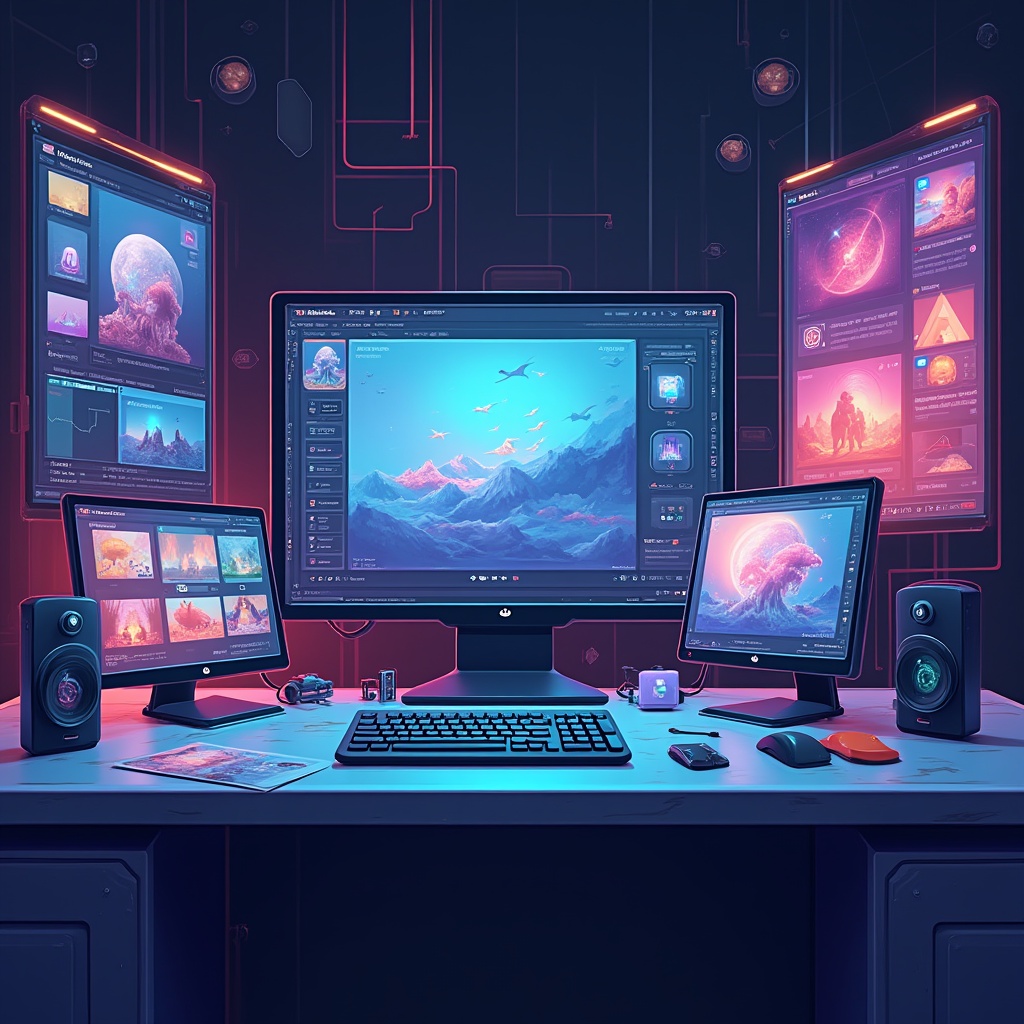
AI Image Maker Free tools let you generate images from text prompts without paying upfront. The best free AI image generators can create social media graphics, concept art, marketing visuals, thumbnails, and creative drafts with no visible watermarks — although free plans may still include limits such as credits, slower generation, lower resolution, account requirements, or invisible metadata.
AI Image Maker Free: The Great Watermark Hunt
So there I was, at 2 AM, generating my 847th AI image of a cat riding a dinosaur — don’t ask — when I realized something kind of depressing: a lot of “free” AI image tools still find a way to make free feel complicated.
Sometimes it is a watermark. Sometimes it is a tiny credit limit that disappears faster than your motivation on a Monday morning. Sometimes it is a signup wall that wants more personal data than your nosy aunt at Thanksgiving.
And sometimes the tool technically gives you free images, but the quality is so rough that your “professional product mockup” looks like it was assembled by a toaster with anxiety.
That is why looking for an AI Image Maker Free tool is not just about finding any free generator. It is about finding one that gives you usable images, reasonable limits, and ideally no visible watermark slapped across your work like a digital “I DIDN’T PAY FOR THIS” sticker.
The good news? There are still solid free AI image makers that can help you create clean visuals without immediately forcing you into a paid plan. The catch is that “free” does not mean the same thing everywhere.
So let’s break down the best free AI image generators with no visible watermarks, what each one is actually good for, and what you need to check before using the images in real projects.
What Is an AI Image Maker Free Tool?
An AI Image Maker Free tool is an online platform that creates images from text prompts without requiring payment upfront. You describe what you want, choose a style or model if available, then generate an image using artificial intelligence.
For example, you can type:
A futuristic coffee shop on Mars, warm neon lighting, cinematic style, wide angle shot.
And the tool will try to generate an image that matches that description.
Behind the scenes, these tools use AI models trained on huge collections of image-text pairs. You do not need to understand the technical side to use them, but it helps to know one simple thing: the better your prompt, the better your result usually gets.
Free AI image makers are useful for:
- Social media posts
- Blog thumbnails
- Creative concept art
- Marketing ideas
- Product mockups
- Presentation visuals
- Website graphics
- Moodboards and design exploration
But free does not always mean unlimited. Most platforms use some kind of limit.
Why “Free AI Image Generator” Gets Complicated
The word “free” sounds simple. In AI tools, it rarely is.
Different platforms define free in different ways:
- Free credits: You get a limited number of generations per day or month.
- Free plan: You can use basic features, but advanced models or higher resolution require payment.
- Free trial: You can test the tool for a limited time before upgrading.
- No visible watermark: The image does not show a logo, but it may still include metadata or content credentials.
- Lower priority generation: Free users may wait longer than paid users.
That is why the best question is not just “Is it free?”
The better question is:
Can I create usable images for my purpose without a visible watermark, without running out immediately, and without violating the platform’s usage rules?
That is the standard this guide uses.
If you use AI visuals for a business website, landing page, SaaS product, or marketing funnel, you may also need stronger design and development support. You can explore
AI Services
from JustOnePrompt for custom AI workflows and content systems.
Best AI Image Maker Free Tools with No Visible Watermarks
Here are the best options to try if you want free AI image generation without obvious branding across the final image.
Important note: free plans change often. Before using any image commercially, check the current license, usage rights, and plan limits on the tool’s website.
1. Microsoft Designer Image Creator
Microsoft Designer is one of the easiest free AI image makers to recommend for beginners. It is clean, simple, and built for people who want quick visuals without learning a complicated creative tool first.
You can use it to create social media graphics, concept images, posters, design ideas, and prompt-based visuals. It is especially useful if you want something polished quickly and do not want to fight with too many settings.
- Best for: beginners, social graphics, marketing visuals, simple creative images.
- Strength: easy prompt-based image creation with a beginner-friendly interface.
- No visible watermark: generally suitable for clean downloads, but always check the current export behavior.
- Watch out for: account requirements, generation limits, and occasional issues with text inside images.
Microsoft Designer is a strong first stop if you just want to type a prompt and get a usable image without learning ten advanced settings.
2. Canva AI Image Generator
Canva’s AI image generator, often used through Magic Media, is perfect if your final goal is not just an image, but a finished design. You can generate an image, then immediately place it inside a post, presentation, thumbnail, poster, or marketing graphic.
This is where Canva shines. It is not only an AI image maker. It is a full design workspace.
- Best for: social posts, thumbnails, presentations, ads, and visual marketing assets.
- Strength: generated images can be edited directly inside Canva templates.
- No visible watermark: useful for clean design work, depending on the asset and plan limits.
- Watch out for: free usage limits and Pro-only design features.
Canva is ideal when you want to create an image and immediately turn it into something publishable.
3. Leonardo.ai
Leonardo.ai is one of the strongest free AI image platforms for people who want more creative control. It offers different models, styles, and settings that can help with character design, game assets, concept art, product visuals, and stylized images.
It may feel a little more advanced than Microsoft Designer or Canva, but that extra control is exactly why many creators like it.
- Best for: concept art, game assets, character ideas, product visuals, and creative exploration.
- Strength: multiple models, style control, and strong creative output.
- No visible watermark: generally useful for clean creative generations, but check current free-plan exports.
- Watch out for: token limits, account requirements, and advanced settings that may confuse beginners at first.
If you want more than “type prompt, get image,” Leonardo is worth learning.
4. Ideogram
Ideogram is especially useful when your image needs text. Most AI image generators still struggle with readable words inside images, but Ideogram has built a reputation for stronger text rendering compared with many general tools.
This makes it useful for posters, logos, typography experiments, quote graphics, stickers, product concepts, and visual ideas where text matters.
- Best for: typography, posters, logo concepts, quote graphics, and images with readable text.
- Strength: better text handling than many AI image tools.
- No visible watermark: commonly used for clean outputs, but review current free-plan terms.
- Watch out for: free generations may be limited, and perfect spelling is still not guaranteed every time.
Use Ideogram when the image needs words inside it and you do not want the AI to invent alien alphabet soup.
5. Playground AI
Playground AI is great for experimentation. It gives users a creative workspace where they can generate, edit, and remix images using AI. It is useful when you want to test styles, create variations, or modify existing outputs.
The editing side is a big part of the appeal. You are not limited to one prompt and one result. You can keep adjusting, extending, and refining.
- Best for: experiments, social visuals, style testing, and image variations.
- Strength: generation plus editing workflows in one place.
- No visible watermark: often suitable for clean creative work, depending on current free-plan rules.
- Watch out for: plan limits and possible changes in free-tier usage.
Playground AI is a good fit when you want to explore multiple visual directions before choosing the best one.
6. Craiyon
Craiyon is one of the simplest free AI image generators. It is not always the most polished option, but it is fast to start with and useful when you need quick visual ideas, memes, rough concepts, or low-pressure experimentation.
Think of Craiyon as a sketchpad, not a final production studio.
- Best for: quick concepts, meme ideas, rough drafts, and casual experimentation.
- Strength: easy access and simple prompt-based generation.
- No visible watermark: useful for quick outputs, but check current download behavior.
- Watch out for: image quality and realism may lag behind stronger tools.
Craiyon is not always where you finish, but it can be a fun place to start.
7. Adobe Firefly
Adobe Firefly is worth including because it is designed with commercial creative workflows in mind. It is especially useful for designers, marketers, and creators who want AI image generation connected to a broader design ecosystem.
Firefly may include content credentials or metadata rather than a visible watermark, depending on current settings and usage. That is not the same as a big logo across the image, but it is still something to understand if you care about labeling AI-generated content.
- Best for: design workflows, commercial-safe creative exploration, and Adobe users.
- Strength: strong integration with Adobe’s creative ecosystem.
- No visible watermark: often clean visually, though metadata/content credentials may apply.
- Watch out for: credit limits, account requirements, and plan-specific usage rules.
Firefly is a smart choice when you care about professional design workflows and clearer usage policies.
8. NightCafe
NightCafe is more community-driven than many tools on this list. It is popular for artistic styles, creative challenges, and generating images that feel more like digital art than standard marketing graphics.
The free side usually works through credits, so it is not unlimited. But for people who enjoy experimenting with styles and participating in a creative community, it can be a fun option.
- Best for: artistic images, digital paintings, style exploration, and community challenges.
- Strength: many styles and a strong creative community.
- No visible watermark: check the current export behavior and plan details before commercial use.
- Watch out for: credit limits and slower workflows if you are generating heavily.
NightCafe is less about pure speed and more about exploring styles and creative directions.
9. Tensor.Art
Tensor.Art is popular with people who want anime, illustration, character design, and model-specific styles. It can feel more technical than beginner tools, but it offers a lot of creative flexibility.
If you are interested in character concepts, stylized art, anime visuals, or more niche aesthetics, Tensor.Art is worth testing.
- Best for: anime art, character illustrations, stylized images, and model-based generation.
- Strength: access to many styles, models, and community-created resources.
- No visible watermark: check current free-plan download behavior and license details.
- Watch out for: the interface may feel more advanced than simple prompt tools.
Tensor.Art is not the simplest AI image maker, but it can produce strong results if you are willing to learn the basics.
Quick Comparison: Which Free AI Image Maker Should You Choose?
If you are not sure where to start, use this simple guide:
- Choose Microsoft Designer if you want the easiest beginner-friendly option.
- Choose Canva if you want to turn images into social posts, thumbnails, and designs.
- Choose Leonardo.ai if you want more control and creative flexibility.
- Choose Ideogram if your image needs readable text.
- Choose Playground AI if you want generation plus editing and variations.
- Choose Craiyon if you want quick rough concepts with minimal friction.
- Choose Adobe Firefly if you care about professional design workflows.
- Choose NightCafe if you want artistic styles and community challenges.
- Choose Tensor.Art if you want anime, illustration, and character-focused results.
Why No Watermark Actually Matters
Watermarks do more than make an image look messy. They change how people perceive the work.
If you are presenting a mockup to a client, posting a graphic on social media, adding a hero image to a website, or testing an ad concept, a big tool logo across the image immediately makes the asset feel less professional.
Watermarks can also create practical problems:
- Client work: branded outputs look unfinished and less professional.
- Social media: watermarked images can feel promotional or low-effort.
- Portfolio pieces: visible branding from another platform distracts from your work.
- Print designs: third-party logos can make the image unusable.
- Website visuals: watermarks damage trust and visual consistency.
That said, “no visible watermark” does not always mean “no tracking or labeling at all.” Some platforms may add invisible metadata, content credentials, or AI labels. These are not always bad, but you should know they exist.
How AI Image Generators Work Without the Jargon
Imagine you studied millions of images and their descriptions. After a while, you would start to understand that “sunset” usually means warm light, orange tones, long shadows, glowing skies, and certain kinds of compositions.
AI image models do something similar, but with math.
Here is the simplified version:
- The model learns patterns: It studies image-text relationships during training.
- You write a prompt: The tool converts your words into something the model can process.
- The image starts as noise: The AI gradually shapes random noise into a picture.
- The tool refines details: It adds structure, lighting, style, objects, and texture.
- You get a final output: Then you can regenerate, edit, upscale, or download.
Different models are good at different things. Some understand complex prompts better. Some are better at photorealism. Some are better at anime. Some are better at typography. That is why the “best” tool depends on what you are trying to create.
Prompt Tips for Better AI Images
The easiest way to improve your results is to improve your prompt.
A weak prompt:
A logo.
A better prompt:
Minimal modern logo concept for an AI automation agency, abstract spark icon, clean geometric style, black and electric blue color palette, white background.
A strong AI image prompt usually includes:
- Subject: what should appear in the image?
- Style: photorealistic, 3D render, flat illustration, cinematic, anime, watercolor.
- Lighting: golden hour, studio lighting, neon glow, soft daylight.
- Composition: close-up, wide shot, centered object, top-down view.
- Purpose: thumbnail, poster, website hero image, product mockup, social post.
- Negative details: what should be avoided, if the tool supports negative prompts.
AI Image Prompt Template
Use this simple template when testing any AI Image Maker Free tool:
Common Myths About Free AI Image Makers
Myth 1: Free Always Means Low Quality
Not anymore. Some free AI image makers use powerful models and produce strong results. The difference is usually in limits: credits, speed, resolution, private generations, editing tools, or advanced controls.
Myth 2: No Watermark Means No Rules
No visible watermark does not mean you can use every image anywhere without checking. Always review the platform’s current terms, especially for commercial use, client work, advertising, and merchandise.
Myth 3: Longer Prompts Always Work Better
Long prompts can help, but only when they are clear. A focused 20-word prompt is usually better than a messy 100-word prompt full of conflicting styles.
Myth 4: AI Image Tools Replace Designers
AI image tools help with speed, ideation, drafts, and visual exploration. They do not replace creative judgment, brand strategy, layout decisions, typography, or professional design thinking.
Myth 5: One Tool Is Best for Everything
No single tool wins every category. The best AI image maker for logos may not be the best for realistic product shots. The best tool for anime may not be the best for social ads. Test based on your use case.
Real-World Uses for Free AI Image Generators
Social Media Creators
Creators use free AI image tools for quote backgrounds, carousel covers, thumbnails, Pinterest graphics, and visual hooks for short-form content. The goal is not always perfect art. Sometimes it is simply creating a strong visual faster.
Small Business Marketing
A local business can create seasonal posters, menu concepts, social media visuals, or ad ideas without hiring a designer for every small update. The best results still need editing, but the first draft becomes much faster.
Bloggers and Website Owners
Blog owners can create featured image concepts, article illustrations, and hero visuals. This is especially useful when stock photos feel too generic or do not match the topic.
Indie Game Developers
Game developers use tools like Leonardo.ai, Tensor.Art, and similar platforms for character ideas, environment concepts, texture inspiration, and moodboards. These images may not become final assets, but they speed up the concept stage.
Agencies and Freelancers
Freelancers can use AI image generators to create mockups, moodboards, campaign directions, and quick visual options before moving into final design work.
If your project needs AI-generated visuals connected to a custom website, SaaS interface, automation system, or product workflow, you can check
Software Development
or
contact JustOnePrompt
for a custom solution.
Final Thoughts
Finding a good AI Image Maker Free tool is not just about avoiding payment. It is about finding the right balance between quality, limits, ease of use, watermarks, and usage rights.
If you want the easiest start, try Microsoft Designer or Canva. If you want more creative control, test Leonardo.ai or Playground AI. If you need text inside images, try Ideogram. If you want quick rough ideas, Craiyon can still be useful. If your style is more artistic, NightCafe and Tensor.Art are worth exploring.
The main thing is to treat AI image generation like a creative draft machine. It helps you move faster, test more ideas, and create visuals you might not have been able to produce from scratch.
But the final judgment is still yours.
The AI can generate the image. You decide whether it actually works.